You book a class, get on a mat or reformer, follow the instructor, and leave feeling stronger and more mobile.
Clinical Pilates looks similar, but the reason you are doing it can be very different.
Instead of starting with a general fitness routine, clinical Pilates starts with an assessment of your body, your movement, your injury history, and your goals.
It may be offered as part of physiotherapy care, or in some settings as part of care provided by another regulated health professional such as a chiropractor. The important part for your benefits is who is providing the service and how that service is billed.
That distinction can matter if you are looking for a way to use your Canadian extended health benefits for movement and rehabilitation.
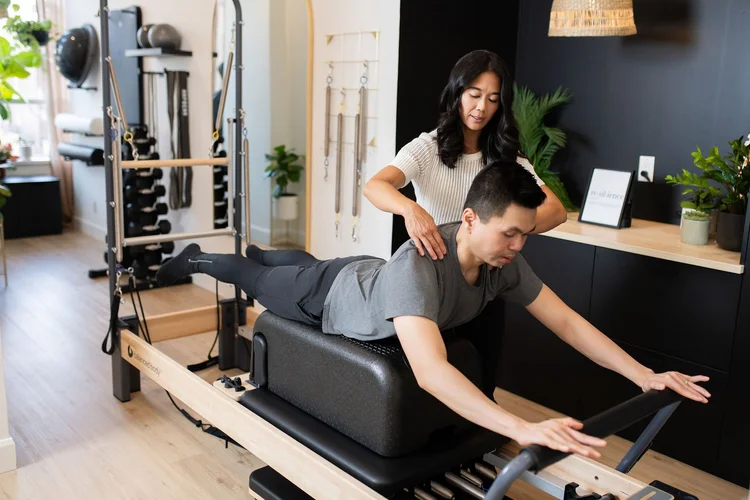
So, what exactly is clinical Pilates?
Clinical Pilates uses the principles of Pilates within a clinical rehabilitation setting.
You still see familiar Pilates movements, controlled breathing, core work, resistance, balance, mobility, and careful movement. The difference is that the exercises are selected based on an assessment of you.
A physiotherapist may look at your strength, mobility, movement patterns, balance, posture, and areas of discomfort before building your program. Canadian clinics offering clinical Pilates commonly describe the assessment as the starting point for creating an individualized program. (Performance Recovery Therapy)
Your program might be designed around:
- Back or neck discomfort
- An old sports injury
- Recovery after surgery
- Hip, knee, or shoulder issues
- Desk job stiffness
- Weakness or poor movement control
- Returning to exercise
- Improving strength and mobility
You do not need to be experienced with Pilates.
In fact, many clinical Pilates programs are designed for people who are completely new to the equipment.
What happens during your first assessment?
Your first appointment is usually more than simply walking into a Pilates class.
Your practitioner will typically ask about your symptoms, previous injuries, daily activities, exercise habits, and goals.
Then they may watch you perform movements such as walking, squatting, lunging, balancing, or Pilates exercises. They may assess your strength, mobility, movement control, posture, and breathing.
The exact assessment depends on the practitioner and your reason for seeking care.
From there, they can decide which exercises and equipment make sense for you.
Some clinics begin using Pilates equipment during the first appointment, while others spend more time assessing and explaining your program first. (Resilience Physiotherapy, Toronto)
The goal is not to find the hardest exercise you can complete.
It is to find the right level of challenge for your body and then gradually progress.
What does a clinical Pilates session look like?
Once your assessment is complete, your sessions may look surprisingly similar to a Pilates class.
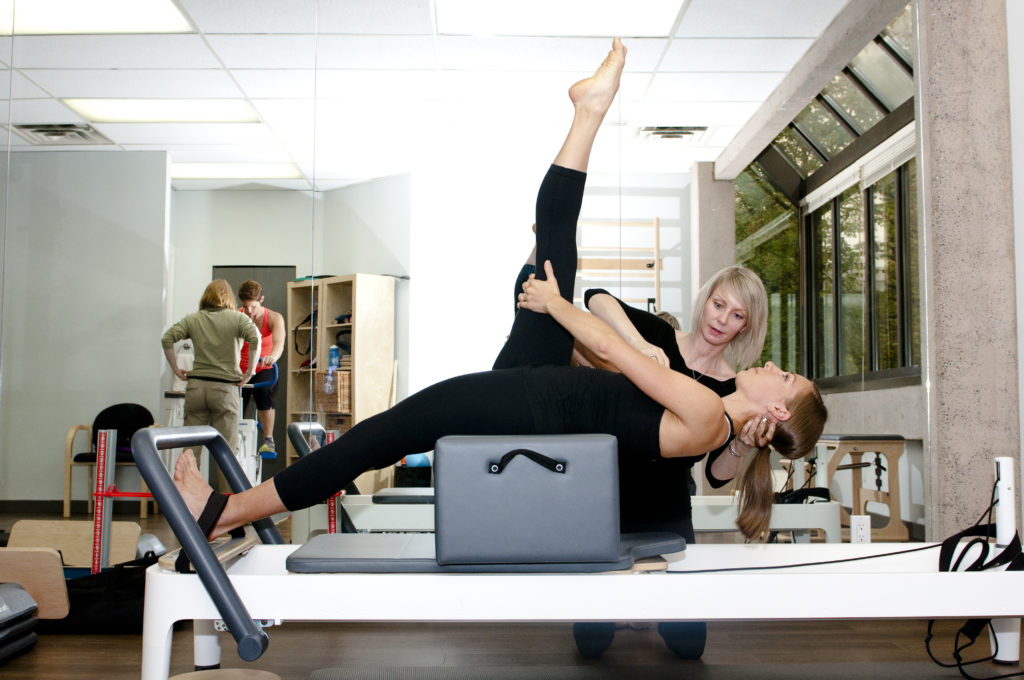
You may lie down, sit, kneel, stand, push against springs, or move your arms and legs through controlled patterns.
The difference is that your practitioner is watching how you move and adjusting the exercise to your needs.
They may change the spring resistance, range of motion, position, number of repetitions, or level of support.
Some sessions may also include mat exercises or other physiotherapy treatment when appropriate. (Resilience Physiotherapy, Toronto)
Over time, exercises can become more challenging as your strength and control improve.
What are the Pilates machines used in clinical Pilates?
You do not need to know the equipment before your first appointment. Your practitioner will show you how everything works.
But if you have seen Pilates equipment online, these are some of the machines you may encounter.
Reformer
The reformer is probably the machine you will recognize first.
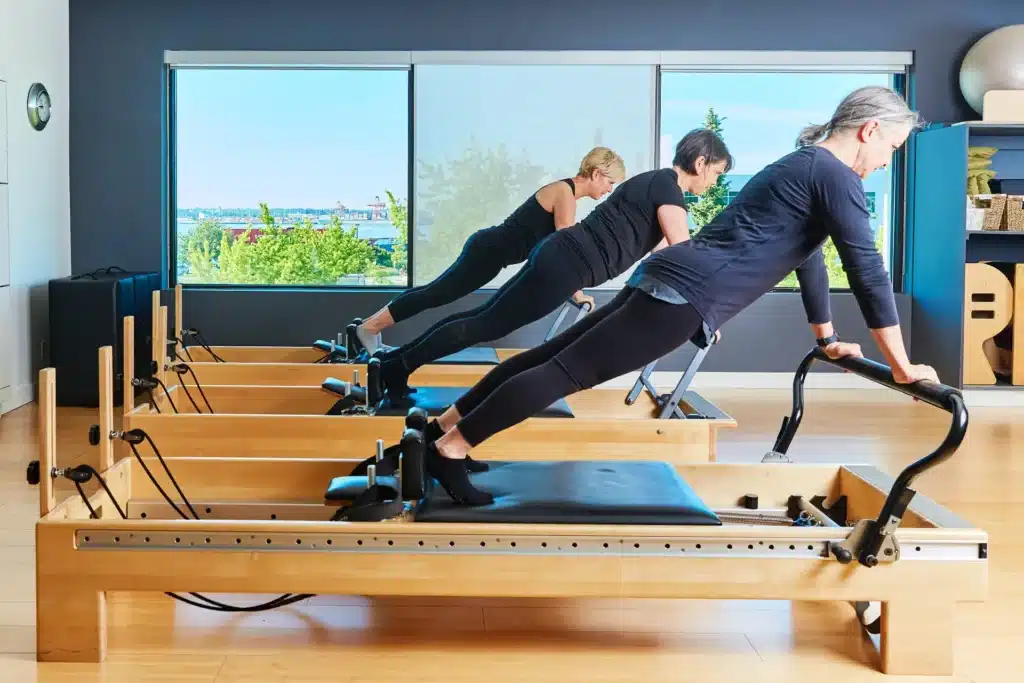
It has a moving platform called a carriage, springs that provide resistance, straps, and a footbar.
The springs can make an exercise more supported or more challenging. This allows your practitioner to adjust the amount of resistance and control required for a movement.
Many Canadian clinical Pilates clinics use reformers as part of rehabilitation programs. (Performance Recovery Therapy)
Cadillac
The Cadillac is a larger piece of equipment with a raised frame, bars, springs, and straps.
It can provide support, resistance, and different ways to position your body.
For someone who is rebuilding strength or learning to control a movement, the equipment can provide useful support while allowing the exercise to be adjusted to their ability.
Tower
A tower is similar to part of the Cadillac setup and uses springs, bars, and attachments to create resistance.
It can be used for controlled strengthening, mobility work, and movement training.
Pilates chair
The Pilates chair is a smaller piece of equipment that can challenge strength, balance, and control.
Your practitioner may use it when you are ready for a different type of resistance or movement challenge.
Smaller equipment
Clinical Pilates can also use simple equipment such as resistance bands, stability balls, foam rollers, rings, and other props.
The machine itself is not what makes Pilates clinical.
The assessment, clinical reasoning, individualized program, and progression are what make the approach different from a standard fitness class. (Cadence Physiotherapy & Rehab)
Can clinical Pilates be claimed through your benefits?
This is where you should slow down before booking.
Clinical Pilates is not automatically an insurance benefit just because it takes place in a clinic.
If a registered physiotherapist provides the service as physiotherapy, the appointment may be eligible under your physiotherapy coverage, depending on your plan. Some Canadian clinics specifically bill clinical Pilates led by a physiotherapist as physiotherapy. (Performance Recovery Therapy)
If a chiropractor provides the service, do not assume it can be submitted under physiotherapy.
Chiropractic and physiotherapy are separate regulated professions. In Ontario, for example, a chiropractor cannot bill a service as physiotherapy unless they are also registered as a physiotherapist. (OCA)
Your safest approach is to ask both the clinic and your insurer.
Before booking, ask:
- Who will provide my session?
- What profession will the service be billed under?
- What will appear on my receipt?
- Is this specific service eligible under my plan?
- Do you offer direct billing?
Your plan may also have annual maximums, per visit limits, deductibles, or other requirements. Some plans may require a referral or other documentation. (Toronto Wellness & Physio Center)
Direct billing also does not guarantee that your plan will pay for the full appointment.
Is clinical Pilates right for you?
Clinical Pilates may be worth exploring if you want more than a general workout.
It can be particularly relevant if you have an old injury, recurring discomfort, movement limitations, or specific strength goals.
It can also be a useful option if you want professional guidance before returning to regular exercise.
You do not have to choose clinical Pilates forever. For many people, it can be one part of a longer movement routine that eventually includes regular Pilates, strength training, sports, walking, or other activities they enjoy.
Find clinical Pilates clinics
If you are curious about clinical Pilates and want to see what is available near you, start by comparing clinics and asking about their practitioners, services, and insurance process.