You booked a golf lesson.
Your PGA professional tells you to rotate more, stay connected, or change your backswing.
You understand the instruction.
But your body does not seem to cooperate.
This is where a TPI based assessment can add another layer.
A PGA golf professional primarily looks at the golf swing and helps you improve how you use the club.
A TPI trained practitioner can look at the relationship between your physical capabilities and your swing.
Neither approach has to replace the other.
In fact, the most useful approach for some golfers may be to understand both the swing problem and the physical limitation that may be contributing to it.
TPI itself describes a team approach involving golf, fitness, and medical professionals. (MyTPI)

What does a PGA golf assessment focus on?
A PGA professional is trained to help you play better golf.
Your assessment may focus on your:
- Grip
- Setup
- Alignment
- Posture
- Backswing
- Downswing
- Impact
- Club path
- Club face
- Ball flight
- Distance
- Consistency
Your instructor may use video, launch monitor data, club data, or other tools to understand what your club and ball are doing.
The outcome is generally a golf instruction plan.
You might leave with drills to practice at the range or at home.
This can be exactly what you need if your main problem is technical.
What does a TPI assessment focus on?
TPI approaches the golf swing through the relationship between the body and the swing.
A TPI physical screen looks at physical capabilities and considers how those findings may relate to swing characteristics. (MyTPI)
Your assessment may explore things such as:
- Mobility
- Stability
- Balance
- Strength
- Movement control
- Rotation
- Physical limitations
- Previous injuries
The results can help determine whether a physical limitation may be relevant to your swing.
TPI offers separate certification pathways for golf, fitness, and medical professionals, so a TPI assessment can look different depending on who provides it. (MyTPI)
TPI led vs PGA led
It is more useful to think about these as different lenses rather than deciding that one is better.
| TPI based assessment | PGA golf assessment | |
|---|---|---|
| Main focus | Body and swing connection | Golf swing and ball flight |
| Looks at | Physical capabilities and movement | Swing mechanics and club delivery |
| Typical provider | TPI Certified medical, fitness, or golf professional | PGA golf professional |
| May include | Movement screens and physical testing | Swing analysis and golf technology |
| Main outcome | Identify physical areas to work on | Identify swing changes and practice drills |
| Insurance | May be eligible when provided as an eligible health service, depending on provider and plan | Generally an out of pocket golf service |
| Best used for | Understanding physical limitations | Improving golf technique |
The important point is that TPI is not synonymous with physiotherapy.
A TPI Certified golf professional and a TPI Certified physiotherapist have different professional backgrounds.
Likewise, being a PGA professional does not prevent someone from having TPI training.
The useful question is not simply:
"Is this TPI or PGA?"
Ask:
"What does this professional specialize in, and what question am I trying to answer?"
When should you start with TPI?
A TPI based assessment may make sense if your golf problem feels physical.
For example, perhaps:
- Your backswing feels restricted.
- You cannot comfortably rotate.
- You lose balance during your swing.
- One side feels significantly weaker.
- You have returned to golf after an injury.
- You have received swing instructions but physically struggle to make the change.
In those situations, understanding your physical capabilities may give you useful information before you spend months trying to force a technical change.
TPI's approach specifically emphasizes assessing physical capabilities rather than assuming what a golfer can or cannot do. (MyTPI)
When should you start with a PGA professional?
If you are healthy and physically comfortable but your ball flight is inconsistent, a golf professional may be the natural starting point.
Maybe you are hitting a slice.
Maybe your driver launch is inconsistent.
Maybe your contact is poor.
Maybe you want more distance.
Maybe you are preparing for your first tournament.
These are fundamentally golf performance questions.
A PGA professional can observe your swing and help translate the problem into a practical golf adjustment.
Why combining both can be useful
This is where things get interesting.
Imagine your golf instructor tells you that you need more rotation in your backswing.
You try.
You cannot do it comfortably.
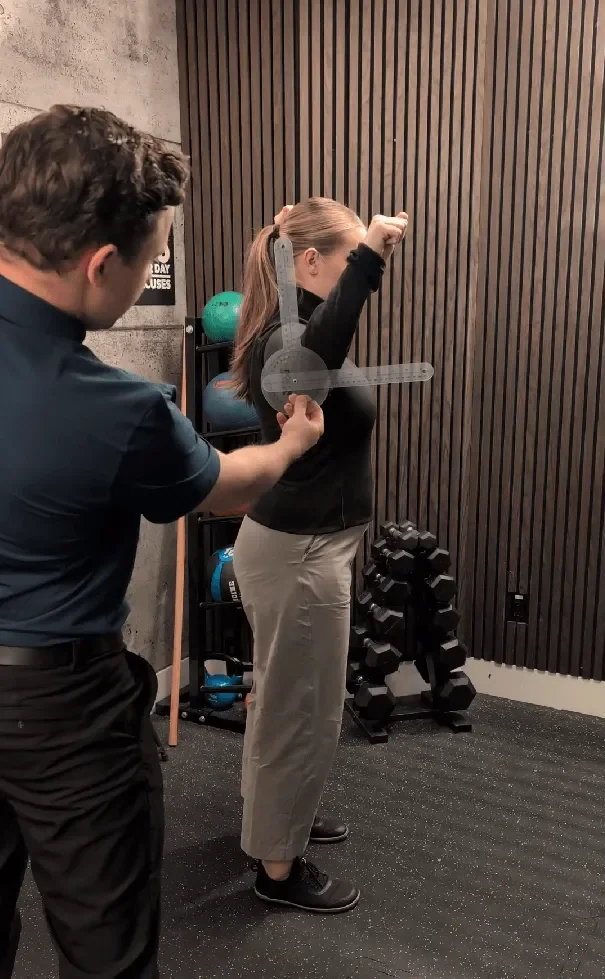
Instead of repeatedly forcing the movement, a TPI trained practitioner could assess whether your physical capabilities are limiting the movement.
If the assessment identifies a mobility or strength issue, you can work on that physical area.
Then you can return to your golf professional and work on the swing change again.
The two professionals are answering different questions.
- PGA: What is happening to my golf swing?
- TPI clinical assessment: What can my body currently do, and could that be influencing my swing?
- Training or rehabilitation: How can I improve the physical limitation?
- PGA coaching: How do I turn that improvement into a better golf swing?
TPI explicitly promotes this type of collaboration between golf, fitness, and medical professionals. (MyTPI)
A practical weekly golf plan
You do not need to see every professional every week.
A simple routine could look like this:
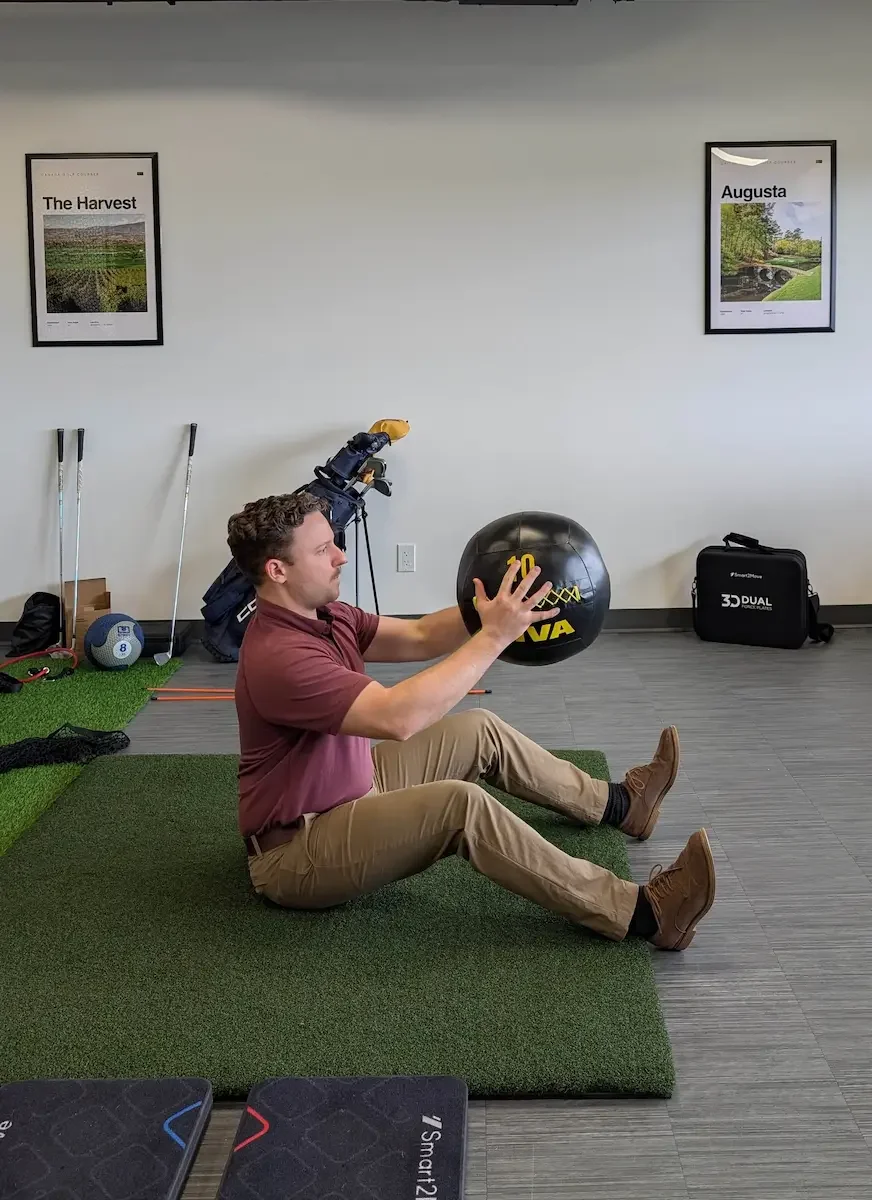
- Monday: TPI based mobility or strength session
- Wednesday: Golf practice with specific drills
- Saturday: PGA golf lesson or playing session
- Sunday: Light mobility and recovery
You could also use a clinical assessment periodically rather than continuously.
For example, you might start the season with a TPI assessment, work on your physical limitations for several weeks, and then have a PGA lesson to apply the changes to your swing.
If pain appears, stop treating it as simply a swing problem and consider getting appropriate clinical advice.
And what about your benefits?
This is another reason to understand the difference.
A PGA golf lesson is generally a golf instruction expense.
A TPI assessment provided by a physiotherapist or chiropractor may potentially fit within your extended health coverage if the service is eligible under that practitioner's benefit category and your plan.
For chiropractic care, the Ontario Chiropractic Association notes that many extended health plans cover chiropractic services, but the insurer determines eligibility under the specific plan. (OCA)
For physiotherapy, the same principle applies: the fact that an assessment uses a TPI framework does not automatically make it a covered physiotherapy service.
Your professional credentials and the way the service is billed matter.
Ask before booking.
The simple way to think about it
You do not have to choose between TPI and PGA.
Think of them as two different pieces of your golf development.
TPI can help you understand the body behind the swing.
PGA instruction can help you understand and change the swing itself.
And when the right professionals work together, you can connect the two.
For many golfers, that means fewer guesses about why a swing change feels impossible and a clearer plan for what to work on next.
Find a golf swing assessment
Looking for a TPI trained physiotherapist, chiropractor, or golf professional?